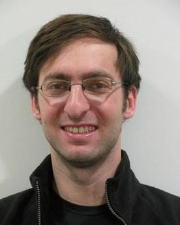
Jeremy Hurwitz
Jeremy Hurwitz is presently a software engineer at Google. Before coming to Google, he received an M.Eng. from MIT and an M.S. from CalTech. His main interests are in the theoretical aspects of Computer Science, including algorithms and complexity theory.
Research Areas
Authored Publications
Sort By
Twenty years of Bigtable
Fabio Baltieri
Bora Beran
Igor Bernstein
Aimee Borda
Adrian Chan
Mark D'Andrea
Artak Dashyan
Ramesh Dharan
Gabor Dinnyes
Mike Dominguez
dorland .
Jose Duenas
Gary Elliott
Bruno Furtado
Madison Garcia
Marçal Garolera Huguet
Brendan Gleason
Alexis Hawkins
Anoshak Irani
Rohit Jog
Sudarshan Kadambi
Vikram Khemka
Sailesh Krishnamurthy
Maxim Krivokon
Bruce Lee
Tom Magrino
Matt Maly
Mark Mangrich
Douglas McErlean
Pablo Montes
Li Moore
Eduardo Morales
Greg Morris
Steve Niemitz
Gaurav Prabhu Gaonkar
Jim Rutherford
Stephen Ryan
Sho Saha
Kanoj Sarcar
Cristina Schmidt
Andrii Shyshkalov
Pratibha Suryadevara
Nick Suttle
Anvit Tawar
John Tobin
Justin Uang
Phaneendhar Vemuru
Harendra Verma
Shitanshu Verma
Jinghang (Frank) Wang
Michal Wegorek
Simon Yau
Andrius Ziukas
SIGMOD Companion '26: Companion of the International Conference on Management of Data, ACM (2026), pp. 188-200
Preview abstract
Bigtable is a pioneering and influential non-relational database system. The original Bigtable paper has been widely cited and it inspired and influenced many other systems such as HBase and Cassandra. Since then, Bigtable has continued to grow and has become one of the largest database systems inside Google. In this paper, we tell the journey of Bigtable inside Google for the last twenty years. We present new features added and improvements made to Bigtable, and we share our experience of running this storage system at scale, continually improving all aspects to accommodate the ever-growing demands of users.
View details
On the k-atomicity-verification problem
Wojciech Golab
The 33rd International Conference on Distributed Computing Systems, IEEE (2013)
Preview abstract
Modern Internet-scale storage systems often provide weak consistency in exchange for better perfor- mance and resilience. An important weak consistency prop- erty is k-atomicity, which bounds the staleness of values returned by read operations. The k-atomicity-verification problem (or k-AV for short) is the problem of deciding whether a given history of operations is k-atomic. The 1-AV problem is equivalent to verifying atomicity/linearizability, a well-known and solved problem. However, for k ? 2, no polynomial-time k-AV algorithm is known.
This paper makes the following contributions towards solving the k-AV problem. First, we present a simple 2- AV algorithm called LBT, which is likely to be efficient (quasilinear) for histories that arise in practice, although it is less efficient (quadratic) in the worst case. Second, we present a more involved 2-AV algorithm called FZF, which runs efficiently (quasilinear) even in the worst case. To our knowledge, these are the first algorithms that solve the 2-AV problem fully. Third, we show that the weighted k-AV problem, a natural extension of the k-AV problem, is NP-complete.
View details
